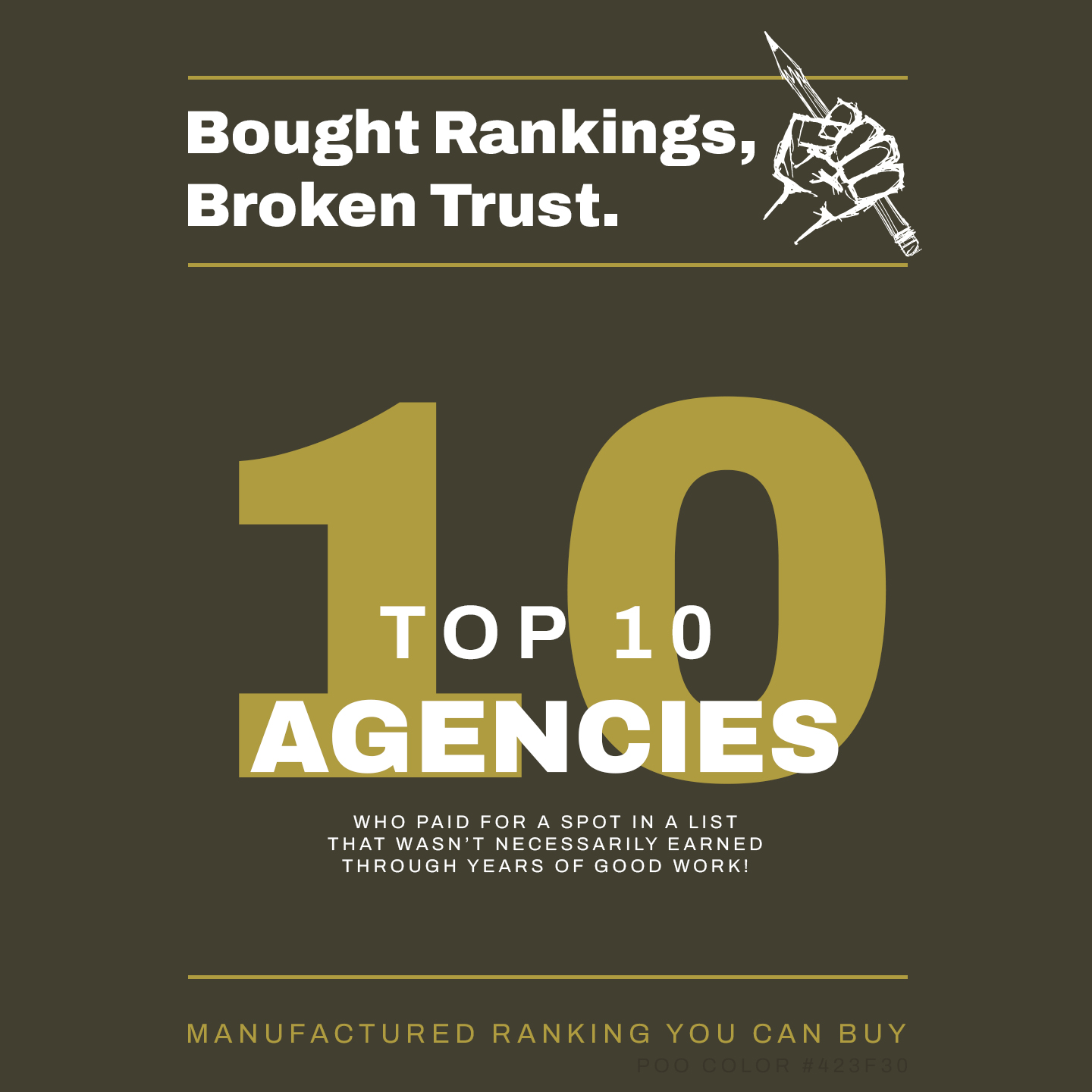
Bought Rankings, Broken Trust
The degradation of trust in online marketing, GEO, and the ease of buying your way onto a "top 10" list that once took years to earn.
For most of my career in design and web development, being named among the best meant something very specific. It meant a portfolio strong enough to survive real scrutiny. It meant a client list built one satisfied referral at a time. It meant peers, people with no reason to flatter you, were willing to vouch for your work in rooms you weren't in. That kind of recognition took years to earn, because it was supposed to. It was a filter, and filters only work if they can't be bypassed.
Increasingly, this one can be.
The shortcut nobody should have built
Search engine optimization taught brands how to be found. Generative Engine Optimization or GEO, the practice of shaping content so AI-driven search and chat tools surface or recommend it, is now teaching brands how to be recommended. Somewhere in the gap between those two disciplines, a market opened up for something that was never supposed to be transactional: rank.
"Top 10 web design agencies." "Best graphic designers in Dublin, Milan or Springbok." "Leading branding studios." Lists like these used to function as informal peer review, compiled by editors or practitioners with some stake in getting it right. Today, a significant number of them are pay-to-play: submission fees, "featured placement" tiers, affiliate arrangements, directory sites that will rank almost any studio willing to buy a badge, a backlink, or a sponsored slot dressed up as editorial judgement. Some of these sites disclose the arrangement clearly. Plenty don’t or bury it in language vague enough to preserve the appearance of independence.
What makes this worse than ordinary advertising is that nobody markets a bought placement as an ad. It's presented as a ranking, a judgement of quality, which is precisely the thing it no longer is.
Where GEO makes it worse, not better
Old-fashioned SEO manipulation was at least visible if you knew where to look, you could inspect a page, spot the keyword stuffing, notice the paid link farm. GEO manipulation is laundered through a layer that feels neutral. When a chatbot or an AI overview recommends "highly rated agencies" and names a handful, most people read that as a machine-generated, objective judgement, not as a summary of whichever directories and listicles happened to rank highest in whatever the system drew on. If those underlying sources were pay-to-play, the AI hasn't removed the bias. It's laundered it, and handed it back with a tone of authority the original listicle never had.
This is the part the industry hasn't fully reckoned with. Optimizing content so a generative engine cites you isn't inherently dishonest, much of it is simply making genuine expertise legible to a new kind of reader. But it sits on the same infrastructure as the pay-to-play lists it often draws from, and it inherits their credibility problem by default, unless someone actively designs against it.
What earned reputation still looks like
None of this is an argument against marketing, or against being findable. A brilliant designer nobody can find isn't much use to a client who needs one. It's an argument for keeping two things distinct: visibility, which can legitimately be built and even paid for, and credibility, which can't be, or shouldn't be sold as if it can.
Real credibility still looks the way it always did. It's a portfolio that holds up to interrogation, process and revisions and outcomes, not just polished final shots. It's references a prospective client can actually call. It's longevity: work that has held up across years of client turnover, platform changes, and passing trends, rather than a handful of recent projects styled for a listicle thumbnail. It's peer recognition that exists independently of any single platform, the kind where three unconnected people in the industry would name you unprompted.
None of that is quick, and none of it is for sale. That's exactly why it still means something.


What actually needs to change
Directories and "best of" platforms need to disclose paid placement clearly, inside the ranking itself, not in a footnote nobody scrolls to. A "top 10" list with three sponsored slots isn't a top 10 list. It's an ad unit wearing editorial styling, and it should say so.
Clients should treat any ranking as a starting point for due diligence, never a substitute for it. Ask how the list was compiled. Ask for references you can actually contact. A studio confident in its work will welcome that scrutiny. One that bought its way onto a list generally won't.
Designers and developers should keep investing in the slow signals, detailed case studies, direct client relationships, work that speaks for itself, even though the fast ones are more tempting than ever. Right now, the gap between bought visibility and earned reputation is wide open and visible to anyone who looks closely. For the moment, that gap is also a competitive advantage for anyone willing to do the harder, slower thing properly.